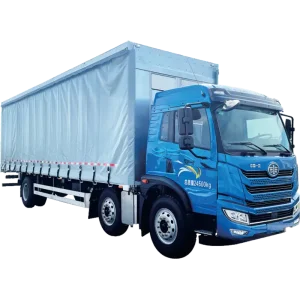
Explore our flagship Day-Old Chick transporters, automated auger bulk feed tankers, and biosecure livestock carriers manufactured to rigorous international agribusiness benchmarks.





In modern intensive poultry integration, the transition period between the hatchery incubator and the brooding facility represents the most fragile phase of broiler and layer development. A Day-Old Chick (DOC) is biologically vulnerable: newly hatched poultry are essentially poikilothermic for the initial 72 hours, possessing minimal internal thermoregulatory capability.
Chicks cannot self-regulate body core temperature. Exposure to air temperatures below 32°C (89.6°F) induces severe hypothermia, dampening vitelline duct absorption. Conversely, ambient conditions above 35°C (95°F) trigger hyperthermic dehydration, degrading 7-day survivability and feed conversion ratios (FCR).
A standard cargo payload carrying 60,000 to 120,000 day-old chicks operates as a high-output biological heat generator, dissipating up to 12 to 15 Watts per thousand chicks alongside massive volumes of CO2. Without active pressurized air exchange, localized CO2 concentrations rapidly surge past dangerous thresholds (>2,500 ppm).
Hatcheries and grand-parent (GP) breeding facilities require near-surgical pathogen barriers. Transport trucks act as mobile bridges between high-containment hatcheries and commercial farms, necessitating completely sealed cabins, HEPA filtration, and corrosion-resistant wash-down architecture.
Driven by large-scale poultry integrators seeking lower Total Cost of Ownership (TCO) and higher chick welfare, the modern chick truck has evolved into a high-precision, smart-controlled, automated mobile incubation ecosystem.
Traditional reefer trucks simply blast cold air against front bulkheads, creating stagnant dead-zones where thousands of chicks suffocate or overheat. GoldBees vehicles utilize CFD-engineered dual-plenum duct systems that channel conditioned air uniformly across every tier of stacking crates from floor to ceiling, maintaining microclimate variance under ±0.5°C across all 120,000 birds.
Equipped with 16 to 32 digital temperature and NDIR CO2 sensors throughout the cabin, GoldBees intelligent control units calculate heat-dissipation trajectories continuously. Data is synchronized in real-time to in-cabin displays and corporate fleet cloud management dashboards, alerting operators to thermal anomalies before distress occurs.
Failure of air conditioning during transit can cause 100% loss of stock within 40 minutes. Modern GoldBees transports feature independent dual HVAC circuits backed by high-capacity diesel generators or onboard battery energy storage systems (BESS), ensuring continuous positive fresh air exchange even during vehicle breakdowns or traffic stalls.
Body interiors are constructed from seamless fiberglass reinforced plastic (FRP) panels bonded to high-density extruded polystyrene (XPS) insulation cores. Completely smooth surfaces, flush-fitting floor channels, and waterproof wiring harnesses (IP67/IP69K) enable pressurized chemical washdown and automated 70°C thermal drying protocols.
When multinational poultry companies (such as CP Group, Tyson Foods, JBS, and BRF) evaluate transport suppliers, initial purchase price accounts for less than 15% of the five-year operational cost equation. The dominant cost factors are in-transit chick cull rates, subsequent 7-day mortality, and fuel efficiency.
| Evaluation Parameter | Standard Conventional Reefer | GoldBees Dedicated Chick Transporter | Economic & Operational Impact |
|---|---|---|---|
| In-Transit Mortality Rate | 0.45% – 1.20% | < 0.05% (Industry Best) | Saves $60,000–$140,000 annually per 10 million chicks transported |
| Cabin Temperature Variance | ± 3.5°C to 5.0°C (Hot/Cold Spots) | ± 0.5°C Across All Crates | Eliminates yolk sac infection triggered by hypothermic transit |
| CO2 Level Concentration | Unmonitored, often > 3,500 ppm | Actively Regulated < 1,500 ppm | Protects respiratory system development, boosting day-7 body weight |
| Air Exchange Mechanism | Recirculation with passive vents | Positive-Pressure Fresh Air Plenum | Guarantees 250–350 m³/h fresh filtered air per 10,000 chicks |
| Auxiliary Power Redundancy | Engine-belt driven compressor only | Dual Independent Diesel GenSet / APU | Zero risk of catastrophic loss during engine stalls or ferry transits |
| Biosecurity Washout Time | 90 – 120 minutes manual clean | 30 – 45 min Flush & Thermal Dry | 35% increase in truck utilization & faster turn-around cycle |
Reducing mortality by merely 0.30% across an operation shipping 20 million chicks annually preserves 60,000 birds. At an average chick value of $0.65 to $0.85, this single metric yields $39,000 to $51,000 in direct annualized profit recovery.
Chicks delivered in optimal microclimate environments experience zero dehydration stress. Data shows an average +5 to +8 grams higher body weight at day 7, accelerating finishing timelines by a full 18 to 24 hours at the processing plant.
GoldBees modular bodies are custom engineered for rapid mounting to global commercial chassis: Scania, Volvo, Mercedes-Benz Actros, MAN, Isuzu Giga, FAW J6P, Sinotruk HOWO, and Foton Auman, meeting local axle weight and turning circle regulations worldwide.
Xinbaiqin Special Vehicle Co., Ltd. operates as the specialized equipment manufacturing vanguard within the industrial umbrella of CP M&E (Charoen Pokphand Group). Located in Cixi, Zhejiang, our modern 66,667 m² industrial facility synthesizes aerospace composite bonding, robotic welding, and automated inspection to build animal logistics equipment with uncompromised endurance.
Cabin composite walls are manufactured using large-format vacuum-pressure laminating tables. Seamless fiberglass sheets are bonded to hydrophobic XPS foam in single passes, eliminating cold bridges and ensuring exceptional structural insulation performance (K-value ≤ 0.35 W/m²K).
Subframes and ventilation ducting are precision laser-cut and CNC bent, followed by automated robotic robotic welding of high-strength alloy frames. This guarantees perfect fitment onto customer-specified chassis without inducing torsional chassis stress.
Every GoldBees vehicle undergoes simulated torrential rain leak testing, thermal imaging leakage inspection, and full-load electrical harness load testing before factory release, ensuring trouble-free commissioning at overseas farm gates.
Poultry production environments vary drastically across continents. GoldBees vehicles are engineered with region-specific configurations to guarantee uninterrupted performance under diverse ecological, legal, and operational constraints.
Conditions: Tropical heat reaching 38°C–42°C paired with relative humidity exceeding 85%.
Engineering Response: High-capacity sub-tropicalized HVAC condensing units, integrated dehumidification coils, and anti-condensation interior ceiling channels that stop water droplets falling directly onto chicks.
Conditions: Desert climates with scorching temperatures up to +52°C, intense solar radiation, and fine airborne dust storms.
Engineering Response: Multi-stage sand-filtration pre-cleaners on air intakes, reflective exterior polyurethane coatings, and dual oversized auxiliary compressors providing continuous 100% cooling redundancy.
Conditions: Extreme winter operations plunging to -35°C, high-speed interstate hauls over 1,200 km, and road salt corrosion.
Engineering Response: Fuel-fired hydronic preheating loops, reinforced 100mm XPS insulated floors, hot-dip galvanized and stainless steel subframe anti-corrosion treatments.
From mega-integrators running multi-million layer facilities to high-altitude regional breeding sites, discover how GoldBees animal transport technology performs in active commercial service.
Challenge: Delivering 80,000 day-old parent stock across mountain passes over 2,800 meters above sea level where thin air reduces oxygen availability and lowers engine cooling capacity.
Solution: GoldBees high-altitude configuration integrates turbo-boosted variable-speed centrifugal blowers that compensate for low air density, ensuring chick lungs receive full oxygenation while maintaining stable internal box barometric pressures.
Challenge: Maintaining strict sanitary integrity and uninterrupted daily distribution for China’s landmark poultry industrial complex.
Solution: Comprehensive deployment of GoldBees automated enclosed Day-Old Chick transporters synchronized with bulk feed auger fleets. Recorded chick journey transit losses dropped below 0.03%, setting a nationwide benchmark for animal welfare and feed biosecurity.
Detailed technical answers to common queries regarding Day-Old Chick truck specifications, microclimate regulation, biosecurity cleaning, and export documentation.
Speak directly with our specialized vehicle engineers. Share your route distance, ambient weather ranges, and desired chick crate capacity for a comprehensive customized proposal.
Beyond day-old chick transporters, Xinbaiqin Special Vehicle (CP M&E) engineers advanced refrigerated semi-trailers, zero-emission NEV electric bulk feed tankers, and humane pig transport units.