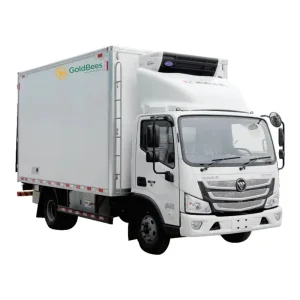
Explore our industrial-grade vehicle platforms precision-engineered by Xinbaiqin and GoldBees for complete biosecurity and supply chain integrity.






In modern industrial poultry farming, the transit window between hatchery incubation and the grow-out brooder farm represents the most biologically vulnerable 24 to 72 hours of a flock's lifecycle.
Extensive zootechnical studies confirm that a 1.5°C fluctuation in chick crate temperature or inadequate fresh air turnover during transit suppresses yolk-sac absorption, permanently damages gut microflora, and spikes 7-day initial mortality by up to 4.2%. High-spec poultry transport vehicles are biological life-support systems, not merely insulated trucks.
Every batch of 50,000 day-old chicks releases approximately 200–280 Watts of sensible and latent metabolic heat per 1,000 birds, alongside excessive carbon dioxide and moisture. Standard refrigerated reefers fail because they recirculate stale air. Dedicated poultry vehicles demand high-volume positive-displacement airflow with dynamic heating and cooling arrays.
With Avian Influenza (HPAI), Salmonella, and Infectious Bronchitis posing existential risks to integrated protein integrators, vehicle hygiene cannot be an afterthought. Factory-engineered chick transporters utilize pharmaceutical-grade FRP panels, sealed stainless electrical conduits, and clean-in-place (CIP) drainage systems built for caustic high-pressure disinfection.
The specialized vehicle manufacturing sector in China has evolved far beyond low-cost fabrication into an agile, technologically advanced ecosystem backed by deep integration with agricultural giants like CP Group.
Factories such as Xinbaiqin work in direct technical alignment with CP M&E. Engineering iterations are validated inside mega-scale commercial hatcheries and poultry integrators holding millions of broilers and layers, closing the feedback loop instantly.
By leveraging high-tensile 6000-series aeronautical aluminum alloys, carbon steel reinforcement in stress joints, and closed-cell polyurethane vacuum sandwich panels, body tare weight is reduced by 18–25% versus conventional European steel bodies.
Chinese special vehicle factories engineer superstructures tailored for global prime movers: European brands (Scania, Volvo, Mercedes-Benz, MAN), Japanese cab-over chassis (Isuzu, Hino), and China's premier heavy platforms (FAW Jiefang, Sinotruk, Foton).
Integrated supply chains in Zhejiang and Shandong clusters allow lead times of 30 to 50 days from engineering sign-off to port departure, compared to 9–14 months typical of Western European boutique coachbuilders.
Comparing high-density day-old chick logistics vehicles engineered for commercial hatcheries and breeding organizations.
| Technical Parameter | Medium Rigid Platform (6x2 / 4x2) | Heavy-Duty Rigid Transporter (8x4) | High-Capacity Semi-Trailer (3-Axle) |
|---|---|---|---|
| Typical Chick Capacity | 35,000 – 55,000 chicks | 65,000 – 85,000 chicks | 100,000 – 140,000 chicks |
| Body Structural System | 80mm FRP Sandwich + PU Core | 90mm Vacuum Insulated Panel (VIP) | 100mm Bio-composite with Polyurea coating |
| Ventilation Flow Rate | 6,000 – 10,000 m³/hr positive push | 12,000 – 16,000 m³/hr stratified | 22,000 – 28,000 m³/hr zone-variable |
| Thermal Range Control | Heating: +18°C to +35°C (±0.5°C) | Heating & Chilling: +15°C to +38°C | Independent multi-zone micro-climate |
| Auxiliary Power Unit (APU) | 15 kW Water-Cooled Diesel Gen-Set | 25 kW Silent Integrated Gen-Set | 35–45 kW Heavy Diesel Generator + Dual Inverters |
| Sensor Array Telematics | 8 Temp/RH + 2 CO2 Probes (CAN-Bus) | 16 Temp/RH + 4 CO2 Probes + Cloud 4G | 28 Wireless Sensors + GPS Geofencing + Blackbox |
| Fresh Air & Filtration | G4 Coarse + Carbon Air Pre-filters | EU4 + Active Carbon Odor Filters | F7 Bio-Safety Fine Filter + Optional HEPA H13 |
| Biosecurity & Washout | Stainless perimeter drains, IP67 wiring | CIP internal spray nozzles, IP68 har-links | Full sloping sanitary deck with air purge valves |
No two poultry integration hubs face identical geographical challenges. GoldBees vehicles are engineered with customized packages for distinct environmental extremes.
Ambient temperatures routinely exceed +50°C. Standard vehicles overheat within minutes. GoldBees equips Saudi, UAE, and Egyptian fleets with dual-stage Carrier or Thermo King refrigeration units, heavy-duty insulated roof deflectors, reinforced condenser fans, and solar-reflective polyurethane external finishes.
With humidity hovering near 90–95%, chicks cannot shed body heat through panting, leading to rapid respiratory acidosis. The engineering response combines high-velocity laminar air extraction, continuous de-humidification cooling coils, and anti-fungal internal surface coatings that prevent mold incubation.
For operations in Kazakhstan, Poland, and Northern China where transit temperatures plunge to -30°C, the cabin is fitted with independent high-efficiency Webasto diesel air heaters, redundant heated air intakes, and thermal floor insulation to prevent cold-bridge mortality in lower crate tiers.
Regulatory scrutiny around animal welfare and carbon footprints is prompting major shifts in how poultry logistics fleets are designed and operated.
Eliminating tailpipe emissions during idling at hatchery loading docks is now mandated in numerous urban farm interfaces. GoldBees NEV platforms utilize high-capacity LFP (Lithium Iron Phosphate) battery packs that power the full climate control system silently for up to 8 hours without running a diesel engine, slashing operating costs by 40%.
Rather than reacting after a temperature drop or CO2 spike occurs, modern CAN-bus telemetry utilizes machine-learning algorithms that adjust airflow dampers, compressor RPM, and heating elements preemptively based on route topography, solar angle, ambient weather forecasts, and bird biomass metabolism.
Adherence to World Organisation for Animal Health (WOAH) guidelines, European Council Regulation (EC) No 1/2005, and global integrator standards (e.g., Aviagen, Cobb-Vantress specifications) requires automated journey data logging. Temperature, humidity, CO2 levels, and door-opening timestamps are uploaded to immutable cloud ledgers for traceability.
When tendering poultry chick transport vehicles, procurement teams must evaluate beyond initial sticker price to guarantee fleet longevity and flock survival.
Does the vehicle feature dual-independent cooling circuits and an automatic APU switchover? A single alternator or compressor failure during a cross-country haul in high heat will wipe out 100% of the cargo within 40 minutes if secondary failsafes are absent.
Ensure crate trolley locking guides provide guaranteed 25mm to 40mm air corridors between stacks. High crate density is commercially desirable, but cramming boxes against side walls blocks return air paths, creating lethal "hot pockets".
Animal transport vehicles are subjected to daily acid/alkaline foaming detergents and chemical fogging. Inspect harness seals (IP68 required), hinge alloys (304/316 grade stainless steel), and seamless floor welding that avoids water entrapment.
Complementing chick transport with bulk feed logistics, automated conveyors, and refrigerated meat supply chains.


Detailed engineering and procurement insights answering common questions from hatchery managers and international fleet directors.
The industry benchmark maintains crate air temperature strictly between +26°C and +29°C (78.8°F to 84.2°F), with relative humidity controlled between 50% and 65%. Chick internal cloacal temperature must stay between 40.0°C and 40.6°C (104°F to 105°F). In addition, carbon dioxide (CO2) concentrations inside the cabin should remain below 1,500 ppm, requiring steady positive-displacement fresh air ventilation.
Standard reefer vans are engineered to maintain cargo temperature in static, inert freight through sealed recirculating air loops. They lack the cubic airflow volume (CFM) necessary to flush out the immense heat output (200W+ per 1,000 birds) and respiratory carbon dioxide emitted by tens of thousands of living chicks. In a closed reefer, suffocating CO2 accumulation and hot spots cause catastrophic mortality within an hour.
Every GoldBees poultry transport vehicle integrates a dual-redundant auxiliary power architecture. If the prime mover tractor unit suffers engine failure, an on-board water-cooled diesel APU (Auxiliary Power Unit) or independent battery system automatically engages within 3 seconds, sustaining full fan circulation, heating, cooling, and telemetry without relying on the truck engine.
Yes. Xinbaiqin supplies either complete fully assembled vehicles (CBU) or knocked-down superstructure kits (CKD/SKD) engineered for local sub-frame mounting. Our engineering design office custom-matches chassis interface dimensions, axle loadings, and electrical harnesses for Scania, Volvo, Mercedes Actros, MAN, Isuzu, Hino, and leading Chinese brands like Sinotruk and FAW.
The interior cargo compartment is designed to IP69K washdown resistance. Wall panels are molded from smooth gel-coated glass-fiber reinforced polymer (FRP) with zero organic cores, bonded seamlessly to eliminate seams and joints where bacteria nest. Decks are equipped with self-draining perimeter stainless channels and high-volume discharge ball valves that withstand aggressive chemical disinfectants.
As part of the CP M&E agricultural equipment industrial division, GoldBees utilizes standardized international Tier-1 components for core wear parts, including Danfoss and Schneider electrical controls, Carrier or Thermo King refrigeration compressors, and Webasto heating systems. Specialized body hardware, sensor modules, and replacement fans are dispatched globally via express air-freight logistics within 48 to 72 hours.
