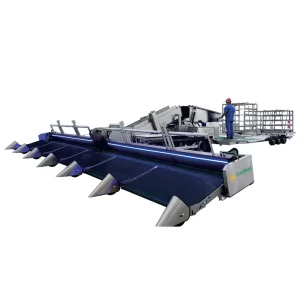
Engineered for minimal mortality rates, zero pathogen vectoring, and optimized payload-to-fuel efficiency under rigorous CE directives.
Transforming live bird logistics from passive crates to active, sensor-controlled mobile biosecurity environments.
Global poultry integrators evaluate commercial transportation based on total lifecycle return on capital. Traditional open-slat trucks lead to significant body weight shrinkage (often 3% to 5%) and elevated Dead-on-Arrival (DOA) metrics. Our CE certified, aerodynamic aerodynamic aluminium bodies provide up to 28% tare reduction, increasing net bird density without exceeding axle load mandates.
High environmental ammonia, extreme summer humidity, and low winter temperatures cause respiratory distress and severe thermal shock in day-old chicks and market-ready broilers. Our closed-loop HVAC units dynamically exchange up to 8,000 m³/h of purified air with continuous relative humidity control, preventing thermal stratification across multi-tiered racking systems.
Cross-contamination during transit remains one of the largest vectors for Highly Pathogenic Avian Influenza (HPAI). Modern poultry transport trucks engineered by Xinbaiqin and GoldBees incorporate positive-pressure HEPA intake filtration combined with UV-C microbial deactivation, guaranteeing that bio-aerosols from infected wild bird flyways cannot enter cargo compartments.
A comprehensive overview of mechanical, electrical, and animal welfare compliance benchmarks.
Guarantees all electro-hydraulic systems—including integrated tail lifts, automated ventilation dampers, and pneumatic crate locks—operate within zero-crush safety tolerances. Complete dual-redundancy interlocks prevent unauthorized door deployment while vehicles are moving or during high-pressure power washing sessions.
All on-board microprocessors, variable-frequency drives, and telematics modules satisfy strict electromagnetic compatibility thresholds. Transmitters and sensors operate seamlessly without interfering with the truck chassis CAN-bus or external roadside telemetry infrastructure, even under heavy RF industrial environments.
Strictly enforced compliance for animal protection during transport. Features continuous data logging for internal ambient temperatures, real-time CO2 ppm monitoring, automated acoustic alerts for driver cabins, and supplemental forced ventilation autonomous systems capable of running uninterrupted for over 4 hours during roadside stops.
The cargo bay is manufactured using anti-corrosive, non-porous 5083/6061-T6 marine-grade aluminum alloy sheets with continuous laser seam welding. Sealed wiring harnesses rated at IP69K ensure the truck resists hot water thermal-chemical sanitation (85°C at 100 bar) and alkaline disinfectants without degrading insulation or structural fasteners.
Designed through rigorous finite element analysis (FEA), the multi-tier superstructure achieves an exceptionally low center of gravity. Multi-point hydraulic leveling balances cargo payload evenly across bogie assemblies, reducing lateral rollover risks on undulating rural agricultural roads and hairpin farm approaches.
Engineered to adapt to disparate geopolitical regulations, climatic extremes, and infrastructure constraints.
Focuses on full compliance with EC 1/2005 animal transport mandates, stringent decibel restrictions during night deliveries near peri-urban centers, and maximum payload efficiencies on 40-tonne gross combination weight (GCW) configurations with Euro 6 / alternative fuel chassis.
Engineered for high ambient heat (up to 48°C) and extreme relative humidity (95%+). Equipped with high-capacity evaporative pre-coolers, secondary auxiliary diesel generators, and oversized axial exhaust fans designed to prevent heat-stress mortalities in congested logistics queues.
Configured for multi-axle semi-trailer configurations, cross-continental transport routes exceeding 1,200 kilometers, integrated telemetry linking directly with corporate ERP platforms, and heavy-duty suspension suited for off-highway gravel road operations between hatcheries and grow-out sites.
Pioneering zero-carbon powertrains, autonomous crate transfer, and IoT biometric health scoring.
Transitioning from mechanical auxiliary engine drives to high-voltage lithium iron phosphate (LFP) battery energy storage systems (BESS). Integrated thermal management systems draw excess heat from motor inverters to warm day-old chick cabins during winter without burning diesel auxiliary fuel.
Seamless synchronization between specialized transport vehicles and automated harvesting machinery. Optical vision-guided conveyor docking systems eliminate manual labor handling, achieving complete truck loading in under 35 minutes while drastically lowering bird stress and wing contusion rates.
Edge-computing arrays in cargo bays analyze bio-acoustic vocalizations, infrared thermal imaging, and ammonia spike patterns. Machine learning algorithms alert dispatchers to microclimate anomalies minutes before stress limits are breached, allowing automated vent modulation in real-time.
Addressing core requirements for fleet directors, farm managers, and biosecurity auditors.
Complete electromechanical equipment solutions for feed mills, brooders, and field transport logistics.