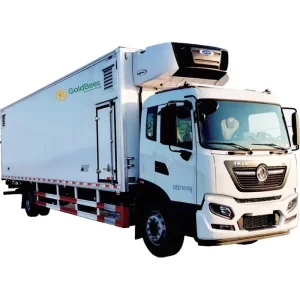
Explore our export-certified line of day-old chick carriers, specialized bulk handling systems, and advanced climate trailers engineered for biosecure farm-to-farm operations.
Day-old chicks (DOC) cannot self-regulate body temperature during their first 72 hours. Modern logistics shifts away from passive draft ventilation toward fully sealed, dynamically air-conditioned isothermal bodies that maintain absolute thermal and biological homeostasis.
The optimal internal crate temperature must be strictly regulated within 30.0°C to 32.5°C with less than ±0.5°C gradient. Modern transport bodies utilize laminar flow air ducts preventing heat-pocket accumulations and chilling hypothermia across complex stacked cargo configurations.
High-density chick crates quickly accumulate carbon dioxide. Dynamic air replacement systems continuously monitor CO2 concentrations, systematically venting when thresholds surpass 1,500 ppm, injecting pre-heated or pre-cooled fresh air to preserve metabolic vigor.
Reinforced fiberglass composite (FRP) sandwich panels with seamless gel-coat surfaces eliminate micro-porosity. Designed to endure high-pressure boiling washouts, chemical fogging, and thermoperformance sanitization without delaminating or absorbing moisture.
Tier-1 integrated hatcheries require standardized equipment architecture meeting strict international certifications, ensuring structural stability, telemetry observability, and cross-border road regulatory compliance.
| Evaluation Parameter | Legacy Open-Louver Fleet | Conventional Reefer Body | CE Certified Isothermal Chick Transporter |
|---|---|---|---|
| Ventilation Aerodynamics | Passive dynamic wind tunnel; massive cargo blindspots | Front-to-back blast; extreme thermal variance | Negative-pressure multidirectional laminar floor-to-ceiling flow |
| Thermal Core Insulation | None; external sheet-metal heat transfer | Polyurethane injected foam (40-60mm) | High-density extruded polystyrene (XPS) + composite glass fibre (80-100mm) |
| CO2 & Air Quality Logic | Unregulated; dependent on vehicle speed | Recirculation dominated; CO2 spike hazards | Autonomous dual-sensor infrared CO2 scavenging with auto air exchange |
| Auxiliary Safety Power | Engine belt only; zero redundancy | Direct truck alternator | Dual redundancy: PTO hydraulics + independent auxiliary diesel generator |
| Compliance Certification | Local road compliance only | General food cold-chain standard | CE Machinery Directive, ATP Isothermal, ECE-R10 Biosecurity protocols |
Xinbaiqin and CP M&E offer comprehensive fleet integration addressing every stage of the animal husbandry lifecycle, synchronizing feed logistics, day-old chick deployment, and cold-chain supply chains.
High-volume auger conveyor semi-trailers and zero-emission NEV pneumatic trucks delivering customized poultry rations directly from feed mills to remote silos with zero environmental contamination and minimal pellet degradation.
Multi-deck transport trailers engineered specifically for breeding herds, broilers, and swine. Equipped with onboard drinking stations, motorized lifting platforms, and automated telemetry tracking to maintain welfare metrics across continental transits.
Advanced refrigerated semi-trailers and distribution vehicles with multi-temperature zone configurations ensuring fresh poultry and processed egg products reach consumer endpoints safely under certified sanitary boundaries.
Xinbaiqin supports clients across Europe, the Americas, the Middle East, and Southeast Asia, engineering bodies compatible with global leading truck chassis manufacturers including Scania, Volvo, Mercedes-Benz, MAN, and ISUZU.
Every GoldBees day-old chick transporter is engineered to satisfy the European Union's CE Machinery Directive (2006/42/EC), Low Voltage Directive, and electromagnetic compatibility standards (ECE R10). Furthermore, structural insulation ratings comply strictly with ATP class FRC/IR standards, providing guaranteed heat transmission coefficients below 0.40 W/(m²·K).
Next-generation vehicles integrate smart IoT sensors reporting real-time box temperature, humidity, static pressure, and crate-level ventilation velocity directly to cloud dashboards. Automated predictive algorithms preemptively adjust heating and ventilation capacity based on external weather telemetry, route topography, and traffic delays.
Key technical, regulatory, and mechanical clarifications for procurement managers, fleet engineers, and hatchery directors.
Explore additional high-capacity cold chain semi-trailers, automated bulk feed haulers, and precision precision poultry carriers built to CP M&E manufacturing standards.