Factory-direct commercial vehicles certified for intense sanitization cycles, animal welfare compliances, and zero cold-bridge food logistics.
In contemporary industrial agribusiness, transport of poultry from concentrated grow-out farms to slaughter and processing facilities represents the most critical biosecurity nexus and economic volatility window. Historical open-sided cage transport exhibits dead-on-arrival (DOA) rates surging above 1.5% to 3.2% in harsh thermal bands, compounded by live-weight shrink (shrinkage loss often exceeding 4.5% over a 4-hour transit), heat stroke, stress-induced muscle glycolysis causing Pale, Soft, and Exudative (PSE) meat, and environmental shedding of avian viral strains.
Manufactured by Xinbaiqin Special Vehicle Co., Ltd. within the CP M&E machinery ecosystem (Charoen Pokphand Group), the GoldBees Slaughterhouse Poultry Transport Vehicles overcome these systematic losses. By marrying high-capacity structural aluminum alloy fabrication with automotive-grade IoT HVAC modules, our enclosed and micro-ventilated transport platforms control absolute internal enthalpy, filter exhaust cross-contamination, and drastically lower operating cost per delivered bird.
Automated positive-pressure and temperature-stabilized airflow limits physiological stress and dehydration, suppressing rapid glycogen breakdown to eliminate dark cutting and PSE carcass rejections at primary processing lines.
High-temperature disinfection tolerance, enclosed effluent catchments, and multi-tier HEPA/carbon filtration intercept feather and fecal dispersion along regional transit corridors, defending national poultry clusters from HPAI and Newcastle disease outbreaks.
Monocoque 6061/6082 aeronautical aluminum profiles decrease unladen vehicle curb weight by 22% to 35% against welded galvanized steel alternatives, instantly amplifying net legal bird payload per transport run.
The convergence of specialized vehicle automotive clusters, domestic metallurgy mastery, and direct integration with massive agribusiness operators.
Our 66,667 m² plant in Cixi integrates precision robotic laser cutting, continuous automatic aluminum extrusion welding, chassis modification, electrostatic dip coating, and final electronics assembly. Direct ownership of every sub-assembly eliminates middleman markups and enforces strict ISO/CE manufacturing controls.
Unlike standard commercial coachbuilders, GoldBees vehicles are engineered hand-in-hand with CP M&E. Prototype units undergo millions of cumulative transport kilometers across tropical heatwaves, high-humidity processing corridors, and severe sub-zero winters prior to commercial factory release.
Bodies are precisely calibrated for integration with Western chassis manufacturers (Scania, Volvo, MAN, Mercedes-Benz) and leading Chinese platforms (FAW Jiefang, Sinotruk HOWO, Dongfeng, Foton). Modular sub-frames match local road dimension and axle weight regulations worldwide.
Key evolutionary directions reshaping slaughterhouse delivery infrastructure through 2030.
The global livestock industry is systematically transitioning away from passive curtain-side trailers toward fully sealed bodies with closed-loop forced ventilation. Dynamic sensors evaluate temperature, relative humidity, CO2 ppm, and NH3 concentrations in real time, modulating variable-speed blowers and evaporative cooling pads to retain uniform cabin environments.
Rising emission restrictions in urban logistics corridors are accelerating the adoption of New Energy Vehicle (NEV) poultry haulers. GoldBees incorporates high-capacity lithium iron phosphate (LiFePO4) auxiliary battery banks that maintain cabin ventilation and cooling during slaughterhouse queue idling without running combustion engines.
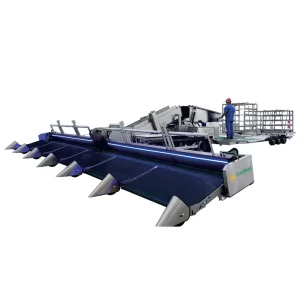
Manual catching accounts for high bird bruising rates and excessive labor turnover. Next-generation transport superstructures feature hydraulic modular drawer systems optimized to couple directly with field automated chicken harvesting machinery, driving catch-to-kill touchless automation.
Tailoring structural configurations to biological traits, ambient climates, and production logistics.
Finished meat birds (35–42 days of age) are exceptionally prone to hyperthermia and suffocation. Vehicles feature high-volume negative/positive pressure ventilation fans capable of refreshing the interior atmosphere within 35 seconds, coupled with roof misting nozzles that depress interior temperatures by 4°C to 8°C under direct summer sunshine.
Neonatal chicks demand narrow thermal envelopes (31°C to 34°C air temperature with minimal turbulence) to avoid yolk sac infection or hypothermic stress. The GoldBees day-old poultry cabin operates as a sterile, positive-pressure mobile incubator.
Multi-deck semi-trailers configured for high-density transport of market pigs or valuable parent stock. Constructed with hydraulic internal elevator platforms that eliminate stressful steep entry ramps.
How multinational protein corporations mitigate regulatory, financial, and operational risk.
Global meat exporters must furnish verifiable digital logs proving that live birds and slaughtered meat did not suffer thermal distress or pathogenetic cross-contamination during transit. GoldBees vehicles feature CAN-bus integrated IoT gateways providing live cloud monitoring of temperature, gate latches, airflow, and disinfection cycle compliance.
Procurement departments cannot afford high maintenance downtime caused by corrosive poultry feces and aggressive foaming detergents. Xinbaiqin builds superstructures using corrosion-resistant 5083/6061 marine-grade alloys and IP69K sealed automotive wiring harnesses, safeguarding electrical reliability over a 10-to-15-year operational lifecycle.
Backed by CP M&E, our manufacturing scope extends beyond poultry vehicles into high-volume electric auger and pneumatic bulk feed semi-trailers, automated chicken harvesters, and cold chain distribution bodies. Large integrators achieve unified fleet telematics and standardized replacement parts through one enterprise manufacturing source.
Engineered for intense duty cycles, biosecure feed handling, automated farm collection, and precision agriculture logistics.
Technical and logistical insights for equipment directors, fleet managers, and agricultural integrators.