Factory-direct manufacturing of certified young poultry vehicles, refrigerated distribution beds, and automated handling systems configured for extreme biosecurity.



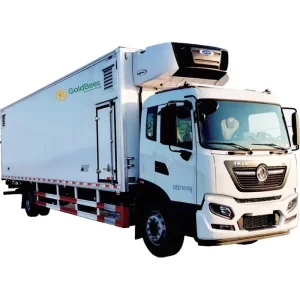



Why traditional livestock transport fails day-old chicks and pullets, and how precision thermodynamic engineering prevents irreversible multi-million dollar flock losses.
In modern intensive poultry farming, the logistical journey between the primary breeding hatchery and the grow-out or layer facility constitutes the single most critical transition phase in an avian life cycle. Day-old chicks (DOC) are biologically poikilothermic within their initial 72 hours; their thermoregulatory physiological mechanisms are fully immature. They cannot actively adjust internal metabolic output to counter ambient temperature spikes or drops. A drop in ambient body envelope temperature below 32°C leads directly to hypothermia, reduced gut development, and non-absorption of the critical yolk sac. Conversely, ambient temperatures exceeding 35°C paired with relative humidity above 65% initiate immediate respiratory panting, severe metabolic dehydration, and systemic carbon dioxide acidosis.
As an authoritative custom manufacturer originating within CP M&E (Charoen Pokphand Group electromechanical wing) and operated through Xinbaiqin Special Vehicle Co., Ltd., our engineering directly tackles the physics of laminar boundary layer thermal transfer. Traditional cargo trailers rely on passive ventilation slits or crude rooftop exhaust fans. These crude airflows generate destructive localized micro-pockets—freezing chicks situated adjacent to sidewall intakes while suffocating those positioned in the core of central stacking dollies.
Independent dual-compressor climate control keeping cargo chamber fluctuation within ±0.3°C, operating seamlessly across ambient exterior differentials ranging from -35°C arctic winters to +48°C hyper-arid desert summers.
Engineered ducted ceiling dispersion ensuring balanced downward vertical airflow. Eliminates stagnant CO2 bubbles and ammonia pockets, supplying guaranteed fresh, oxygenated, HEPA-filtered air to every single crate quadrant.
Seamless sandwich composite wall skins constructed with antibacterial food-grade gel coats. Integrated floor evacuation gutters and full-perimeter rubber gasketing resist caustic automated chemical washdowns and 80°C thermal bakeouts.
Analyzing international trade restrictions, carbon footprint targets, and animal welfare regulations across core agricultural continents.
The commercial landscape of young poultry transit has shifted drastically over the past five years. Stringent regulatory frameworks, such as the European Union’s Council Regulation (EC) No 1/2005 on the protection of animals during transport, combined with impending updates regarding maximum allowable transit durations, now dictate strict telemetric audit trails. Transport operators are legally obligated to record, store, and present real-time telemetry proving temperature variations remained within defined physiological comfort bands throughout journey checkpoints.
Simultaneously, massive industrialization in Southeast Asia, Latin America, and Sub-Saharan Africa has driven poultry consolidation. Megafarms featuring multi-million-bird capacities are routinely situated 300 to 800 kilometers away from grandparent/parent stock hatcheries to preserve biological isolation zones. This spatial dispersion makes long-haul transport vehicles the most vulnerable bridge in the supply chain. A breakdown in transit climate or bio-exclusion results in catastrophic financial repercussions: reduced first-week survivability, stunted Flock Uniformity Index (FUI), degraded Feed Conversion Ratios (FCR), and elevated mortality upon arrival.
| Geographic Region | Primary Compliance Standard | Core Mechanical Mandate | GoldBees Factory Solution |
|---|---|---|---|
| European Union | EC No 1/2005 & Welfare Directives | Continuous thermal logging, fail-safe ventilation, alert alarms | Dual-system digital telematics, redundant secondary diesel generator units |
| North America | USDA-APHIS / Transport of Animals Acts | Cross-border disinfection resilience, winter de-icing preservation | High-output hydronic pre-heaters, insulated insulated composite panels (R-value > 25) |
| Southeast Asia / LatAm | Tropical Heat-Stress Mitigation Acts | High-volume dehumidification, hyper-ambient heat extraction | Tropical-spec evaporator coils, evaporative misting grids, high-CFM vortex fans |
| Middle East / GCC | Extreme Ambient Survival Norms | Operation under 50°C+ exterior ground heat and airborne dust storms | Multi-stage cyclonic air-intake sand filters, heavy-duty secondary radiators |
Ensuring zero cross-contamination and mechanical compatibility across domestic and international commercial vehicle chassis.
Custom modular interface brackets compatible with Mercedes-Benz, Scania, Volvo, MAN, Isuzu, Hino, FAW, and Dongfeng commercial frames.
Engineered power take-off (PTO) hydro-electric systems, auxiliary silent onboard diesel gen-sets, and regional grid shore-power plug compatibility (380V/480V 50/60Hz).
Standardization using tier-one global electro-mechanical actuators, Danfoss refrigeration valves, Schneider logic controllers, and standard metric seals.
Electrics rated to IP69K high-pressure steam resistance. Smooth internal welds eliminate harborage points for Salmonella, Campylobacter, and Avian Influenza.
How GoldBees specialized bodies perform across varied multi-tier logistics environments.
High-density stacking configurations carrying 40,000 to 120,000 day-old chicks per transit run. Air circulation systems feature laminar down-draft circulation capable of exchanging the entire internal cargo air volume 60 to 90 times per hour, guaranteeing carbon dioxide levels strictly below 1,500 ppm while maintaining relative humidity between 55% and 65%.
Heavy-duty open-air or controlled curtain-sided broiler trucks designed for high-stress final transit. Seamless structural integration allows compatibility with automated factory chicken harvesters and modular container loading, slashing bird bruising, bone fractures, and pre-slaughter heat stress by up to 74%.
Ultra-high-value genetic stock carrier trailers equipped with multi-stage HEPA filtration (MERV 17+), biological UV-C air irradiation chambers, active positive interior cabin pressure, and pneumatic air suspension dampening to shield young breeding birds from mechanical shock and vibration stress.
Forward-looking research initiatives driving decarbonization, algorithmic animal welfare monitoring, and predictive microclimate control.
Transitioning regional young poultry transport towards zero tailpipe emissions. Dedicated high-capacity lithium iron phosphate (LiFePO4) auxiliary battery architectures sustain HVAC systems during loading and unloading without truck engine idling.
Integrating IoT sensor clusters with neural network edge computing to predict cargo heat output based on chick hatch batch weight, humidity trends, and external weather routing, dynamically adjusting HVAC fans before temperature spikes occur.
Deployment of non-invasive acoustic sensors and machine-vision cameras capable of analyzing chick distress vocalizations in real time, automatically modulating ventilation velocity to soothe flocks and prevent transit-induced weight loss.
Key considerations for fleet managers, hatchery directors, and procurement teams evaluating young poultry vehicle investments.
Our GoldBees transport bodies utilize a forced down-draft plenum system. Conditioned, filtered air is pushed through calibrated overhead perforated air ducts, forced down vertically through the stacked chick boxes, and extracted via lower side-wall return plenums. This eliminates the "chimney effect" and hot-spots, ensuring air speed across each crate does not exceed 0.2 m/s (avoiding wind-chill hypothermia) while maintaining temperature within ±0.3°C across the entire cargo bay.
Yes. As a primary OEM/ODM manufacturer, Xinbaiqin engineers specialized subframes tailored to any major commercial chassis including Scania, Mercedes-Benz, Volvo, Isuzu, FAW, Foton, and Sinotruk. We deliver either complete fully assembled vehicles or completely knocked down (CKD) / semi-knocked down (SKD) superstructures designed for bolt-on integration in your local assembly plant.
Every GoldBees climate-controlled poultry transport vehicle is equipped with an automated emergency redundancy protocol. If the vehicle alternator or PTO detects engine failure, an integrated silent diesel auxiliary generator kicks in automatically within 8 seconds to run full HVAC, ventilation, and telemetry. In addition, an automatic safety shutter system immediately opens auxiliary fresh-air ventilation flaps to prevent carbon dioxide suffocation.
The cargo interior is manufactured from vacuum-bonded, fiber-reinforced composite sandwich panels bonded with food-grade gel coats that possess zero organic porosity. Joints are rounded and sealed using chemical-resistant polyurethane elastomer. All electrical wiring harnesses are encapsulated in IP69K sealed conduits, and the drainage system features automated one-way anti-backflow wash ports capable of handling high-pressure hot caustic foaming agents and formalins.
We supply full CE certification, ISO9001 quality management compliance, Certificate of Conformity (COC), SASO, ADR compliance documentation for international logistics, and localized test certificates covering electromagnetic compatibility (EMC) and thermal insulation leakage rates.
Explore our complete portfolio of animal husbandry special vehicles, high-capacity poultry harvesters, and precision feed machinery.



