

Precision handling from feed mill bulk production to nursery and fattening pen dry/wet dispensers.


From labor-intensive trough handling to sensor-driven closed loop nutrition: how modern commercial swineries achieve sub-2.4 Feed Conversion Ratios.
The global commercial swine production paradigm has entered an era governed by ultra-tight margins, aggressive biosecurity regulations (principally surrounding African Swine Fever and PRRS mitigation), and rigorous carbon footprint accounting. At the operational center of this transformation is the feeding system. Historically divided between manual dry self-feeders and capital-intensive centralized liquid feeding rings, contemporary swine operations have converged around Automatic Dry/Wet Feeding Systems as the optimal balance of biological performance and mechanical resilience.
In mature agricultural markets across North America, the European Union, and rapidly consolidating mega-production complexes in East and Southeast Asia, dry/wet feeders represent the baseline engineering standard for wean-to-finish facilities. Dry/wet feeding delivers mash or pelleted feed adjacent to integrated low-pressure drinking nipples inside a heavy-gauge stainless steel trough. Pigs naturally create an ad-libitum slurry mix right before ingestion. This physiological optimization enhances feed palatability, shortens meal duration, lowers digestive energy loss, and dramatically mitigates the dust generation typical of conventional dry feeders.
The engineering challenge, however, extends far beyond the trough. Industrial swine integrity requires an uninterrupted cold chain and bulk logistics continuity — beginning from raw material processing at the feed mill, moving through specialized biosecure bulk feed pneumatic and auger trucks, transferring to sealed farm silos, and distributing through computerized automated overhead drag chain or auger conduits straight into self-cleaning dry/wet dispensers. When engineered systematically, producers routinely realize a 0.15 to 0.25 improvement in Feed Conversion Ratio (FCR) while lowering water trough overflow by up to 50%.
Mechanical reliability meets biological precision: high-grade structural alloys, anti-bridging agitators, and micro-metering valves.
Engineered without right-angle weld seams to eliminate bacterial harboring pockets. The hydraulic deep-drawn 1.5mm–2.0mm SUS304 pan withstands aggressive organic acids, high-pressure foam washdowns, and thermal drying cycles.
Double-sided feeding geometry allows 40 to 60 nursery or finishing pigs simultaneous access while curved separation dividers prevent aggression and ear biting.
Precision multi-gear indexing plates offer finite adjustment of dry meal dispersion from 20g/action up to bulk flows. This prevents feeder jamming, feed crusting, and trough stagnation.
Swine easily actuate mechanical stainless pendulum rockers or trigger paddles, dropping controlled amounts of dry pellets directly onto wet feeding shelves.
Incorporates integrated stainless steel water conduits terminating at protected low-pressure silicone-damped nipples positioned above the trough pan. Water flow is calibrated to maintain an optimal 2.5:1 to 3:1 water-to-dry-matter slurry consistency.
This biological sweet spot ensures instant ingestion without triggering premature fermentation in ambient shed temperatures exceeding 30°C.
A holistic view of livestock nutrition logistics: preventing structural pellet degradation and microbial vector transfer across the transport chain.
Formulation durability index (PDI) must exceed 96% to survive hydraulic mechanical transit without pulverization. We deliver custom feed mill plant infrastructure tailored to livestock compounders.
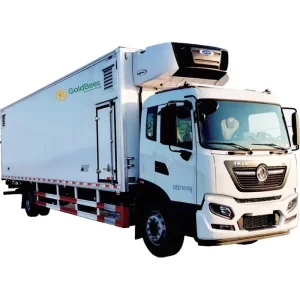
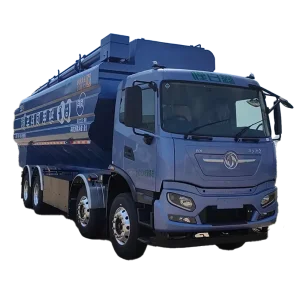
Utilizing GoldBees multi-compartment auger and pneumatic bulk trucks (including NEV platforms) equipped with wireless discharge speed throttling to keep pellet fracture below 1.2% during silo loading.
Heavy-duty, high-tensile disc chain loops and hardened PVC conduit systems deliver feed continuously from external quarantine silos directly into house drop pipes without human cross-barn contamination.
Ad-libitum dry/wet feeders receive dry supply on demand. Sensor-interlocked level switches trigger batch top-ups, guaranteeing feed freshness and zero residual spoilage 24/7/365.
Tailoring flow mechanics, anti-condensation coatings, and water line thermal isolation to diverse geographical farming landscapes.
Primary Hazard: Extreme ambient humidity triggers feed caking inside drop tubes; rapid mycotoxin proliferation in damp troughs.
Engineering Response: Hopper cones feature hydrophobic electro-polished internal surfaces and sealed pneumatic vibrator baffles. Water pressure manifolds feature automatic flushing cycles to avoid stagnant bacterial growth during mid-day heat spikes.
Primary Hazard: Water nipple freezing, feed thermal bridging, and severe building drafts causing pig reluctance to leave creep areas.
Engineering Response: Integration of recirculating glycol/electric trace line jackets along central water delivery headers. Reinforced structural bases anchor solidly into concrete slatted floors to resist ground frost heaving.
Primary Hazard: Extreme vertical head pressures in feed conveyors; hyper-dense biosecurity protocols demanding zero manual maintenance.
Engineering Response: High-torque modular drive units coupled with optical load-monitoring sensors. Dry/wet feeder bodies designed for quick-latch automated CIP (Clean-in-Place) spray-nozzle docking during room turnarounds.
How edge computing, optical ingestion tracking, and automated multi-phase blending will redefine swine farm feeding through 2030.
Real-time silo load monitoring, automated batch transfers, and centralized cloud alarms alerting managers to feed runouts or waterline pressure drops.
Over-pen 3D depth cameras tracking feeding frequency and duration per animal, identifying respiratory onset or illness up to 48 hours before clinical symptoms.
Micro-dosing feeders blending two dietary density lines right in the hopper to match the biological growth curve of individual pen cohorts on a daily basis.
Direct interconnectivity between digital slaughter plant feedback (carcass lean yield), pen feeder adjustment, and autonomous bulk transport truck dispatching.
Critical answers for swine farm owners, agricultural EPC contractors, and procurement engineers evaluating system conversions.
Precision handling from feed mill bulk production to nursery and fattening pen dry/wet dispensers.




