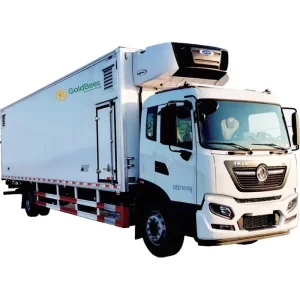
Engineered by Xinbaiqin Special Vehicle (CP M&E Group) for demanding bio-safety standards and minimal mortality.






Day-old chicks lack homeothermic regulation during their initial 72 hours. Transporting millions of chicks across inter-provincial or transnational corridors requires aerospace-grade climate containment, precision laminar airflow, and biosecurity fail-safes.
Modern mega-hatcheries now yield capacities over 100 million birds annually. As production clusters decouple geographically from broiler grow-out farms, single-trip transit times frequently exceed 12 to 36 hours, elevating the DOC transport vehicle from simple rolling stock to an mission-critical incubation chamber on wheels.
A day-old chick produces 2 to 4 Watts of metabolic heat while expelling moisture and CO2. Without uninterrupted constant-volume laminar ventilation, internal box temperatures spike past 38°C (100.4°F) causing thermal shock, yolk-sac degradation, dehydration, and irreversible 7-day post-placement mortality.
Highly Pathogenic Avian Influenza (HPAI) and Salmonella threats demand non-porous antimicrobial surfaces. Conventional insulated truck bodies harbor microbes in rivet seams and foam gaps; GoldBees bodies utilize one-piece structural composite panels resistant to high-pressure thermal vapor washdowns.
Combining CP Group's agro-industrial operating knowledge with China's tier-one automotive supply chain, Xinbaiqin delivers world-class vehicles with unrivaled build speed, cost advantage, and tailored chassis adaptability.
Operating across a 66,667 m² modern industrial site in Cixi, Zhejiang, we manage body design, precision laser cutting, modular welding, electro-hydraulic systems, and microprocessor programming under one roof. Our 2,000+ unit yearly capacity eliminates subcontracting markups and accelerates turnaround cycles.
GoldBees climate modules mount seamlessly to global chassis platforms: Mercedes-Benz, Scania, Volvo, MAN, Isuzu, as well as high-torque domestic platforms including FAW Jiefang, Sinotruk HOWO, Foton Auman, and Dongfeng. Custom subframes ensure compliance with diverse regional axle-load limits.
Equipped with auxiliary onboard diesel generators or high-density lithium ESS packs. Even when navigating steep climbs, idling during border inspections, or in the event of main chassis engine failure, the environmental climate system maintains target temperatures (30°C–32°C) without deviation.
Continuous dynamic environmental balancing designed around animal welfare regulations and integrated herd management systems.
Floor-to-ceiling negative pressure air circulation channels eliminate stagnant air pockets. Conditioned fresh air is filtered via G4/F7 intake elements, distributed across each chick crate row, and expelled through automated back-draft louvers.
Integrated NDIR sensors continuously monitor CO2 levels, automatically triggering high-output fresh air intake blowers whenever carbon dioxide exceeds 1,500 PPM, preventing metabolic acidosis during long transit hauls.
Drivers monitor multi-zone cabin temperatures via a 10-inch ruggedized touch HMI. Fleet managers review global GPS routes, live box temperatures, vibration indices, and door-opening sensor telemetry in real time via API or cloud portals.
Poultry farming environments present extreme climatic variances. Xinbaiqin configures body insulation, thermal systems, and air filtration to match local environmental realities across five continents.
Southeast Asia, Brazil, Central Africa: High ambient heat (+42°C) and relative humidity exceeding 85% overload standard condensers. We engineer oversized dual-circuit refrigeration compressors, high-velocity condenser fans, and dehumidification cycles to prevent heat prostration.
Eastern Europe, Northern China, Central Asia: Transits in -30°C winter conditions cause immediate chick hypothermia. Bodies feature 100mm high-density polyurethane insulation cores, auxiliary independent water-heating fuel boilers, and insulated intake dampers.
Middle East & North Africa: Fine airborne dust clogs radiators and suffocates birds. Multi-stage cyclone pre-filters and high-capacity dust-collection filtration protect ventilation ducts, ensuring uncompromised static pressure and air purity.
Latin American Andes & Inland Plateaus: Thin air and rough road surfaces cause excessive vibration stress. Reinforced subframes with air-suspension levelling keep chicks stable, while turbo-boosted auxiliary air generators offset lower atmospheric density.
Global poultry enterprises (Tyson, CP Group, JBS, BRF, Cargill partners) are transitioning from low-spec box trucks to precision logistics assets. Here is what leading procurement officers evaluate.
Global supermarket chains and export regulations mandate auditable animal transport telemetry. Fleets must present timestamped temperature, CO2, and humidity records proving adherence to humane transit limits prior to slaughterhouse or grow-out farm intake.
With corporate carbon-reduction mandates (ESG Scope 1 & 2), integrators are adopting hybrid and full-electric (NEV) transport chassis for local hatchery-to-farm runs under 200 km, reducing operational fueling costs by up to 45% and eliminating terminal emissions.
Manual loading of 100,000 chicks can take several hours, during which box temperatures fluctuate dangerously. Modern fleet specs prioritize hydraulic tail-lifts, roller-bed floors, and crate geometries compatible with automated hatchery loading robots.
Authoritative technical guidance for fleet managers, transport directors, and poultry equipment distributors.
The optimal internal crate microclimate is 30°C to 32°C (86°F to 89.6°F) with relative humidity maintained between 50% and 65%. Air velocity directly contacting the chicks must remain below 0.2 m/s to prevent evaporative chilling, while overall compartment air renewal must guarantee fresh air exchange within 45 to 60 seconds.
Our bodies are manufactured from seamless glass-fiber reinforced polymer (FRP) skins laminated over high-density structural foam cores, leaving zero open joints. The electrical wiring is IP69K waterproof-rated, allowing high-pressure hot water (85°C) and corrosive foam sanitizers (peracetic acid, quaternary ammonium) to be applied and thermal-baked dry safely.
Yes. For markets with high complete-vehicle tariffs or strict localized chassis homologation laws (e.g., Southeast Asia, South America, EU), Xinbaiqin supplies Complete Knock Down (CKD) or Semi-Knocked Down (SKD) body kits with comprehensive structural sub-assemblies, HVAC packages, and wiring harnesses for local installation.
GoldBees DOC vehicles feature a fully automatic dual-source redundancy architecture. If the main PTO or chassis engine drops below operating RPM, an onboard auxiliary generator automatically starts within 8 seconds, maintaining full capacity across all ventilation blowers, heating elements, and refrigeration units.
Complete farming logistics ecosystems engineered for biosecure farm-to-processing operations.