Specialized transport assets engineered for precision agriculture, rapid discharge, and strict farm-gate sanitary compliance.





Addressing structural shifts across livestock aggregation hubs: transitioning from packaged delivery to automated, sealed small-to-medium bulk feed transit.
Global aquaculture and livestock integrators face critical labor shortages. Small bulk feed trailers eliminate manual bag handling entirely, utilizing electric/hydraulic auger systems to offload upwards of 1.2 metric tons per minute directly into overhead farm silos.
Controlling African Swine Fever (ASF) and Avian Influenza demands strict zoning. Small bulk trailers operate as decentralized satellite units, isolating delivery to farm perimeters and undergoing high-pressure chemical wash-down and thermal bake cycles without component corrosion.
Unlike massive 40-tonne articulated bulk trucks, small bulk feed trailers (ranging from 6m³ to 18m³) are engineered with shorter wheelbases and dual-axle configurations, navigating narrow rural roadways, low overhead farm gates, and soft-ground poultry houses with ease.
Built under rigorous Charoen Pokphand Group (CP M&E) industrial benchmarks to guarantee zero cross-contamination and lower total operating expenditure.
Constructed utilizing high-strength 6061-T6 aluminum alloys and high-tensile marine-grade steel (QSTE700TM). This balances rigid structural durability with lightweight tare metrics, expanding legal payload capacity per run by up to 18% over conventional sheet-metal bodies.
Equipped with dual-mode electric augers or tractor-coupled PTO hydraulics. The continuous variable-speed auger screw eliminates particle friction, maintaining critical pellet nutrition and structural integrity with less than 0.2% fines generation across sensitive swine creep feeds.
Every small bulk feed unit complies with international axle load limits, braking specifications (E-mark, ADR, and DOT brake certifications), lighting, and chassis coupling standards, ensuring seamless on-road integration across North America, Europe, Australia, and ASEAN territories.
Architecting the next phase of precision supply networks through continuous sensorization, zero-carbon propulsion, and automated inventory systems.
Real-time load-cell weight telemetry linked via 4G/5G edge modules, synchronizing trailer discharge metrics directly with central enterprise ERP feed systems.
Built-in Clean-In-Place misting nozzles for automated internal tank sterilization and residue removal between formulation batches.
High-voltage battery-electric auxiliary packs eliminating idling tractor diesel consumption during stationary silo discharge.
Vibration and torque monitoring nodes that forecast auger wear patterns, virtually eliminating roadside or farm-gate equipment down-time.
In-depth responses resolving engineering questions, maintenance profiles, and international supply chain assurances.
Our small bulk feed trailer configurations typically range from 6 m³ to 18 m³ (approx. 4 to 12 metric tons payload capacity depending on bulk feed bulk density). These are designed specifically for agility on restricted roads while maintaining high-throughput output via fast hydraulic or electric augers.
We deploy oversized conveyor troughs paired with low-RPM, high-torque helical augers. By reducing rotational velocity and maximizing volumetric displacement, pellet-to-steel friction is substantially suppressed, holding pellet breakage rates under 0.2% across sensitive pellets and premixes.
Yes. Our tanks can be engineered with 2 to 4 independent, hermetically sealed bulk bins with isolated hopper gates and dedicated clean-out access. This allows simultaneous haulage of starter, grower, or medicated feeds in a single route without cross-contamination.
Every GoldBees vehicle is supported with structural chassis warranties up to 3 years and comprehensive 1-year electrical/hydraulic warranties. We supply pre-packaged critical spare parts, detailed English maintenance manuals, and direct engineering consults via video link or regional field agents.
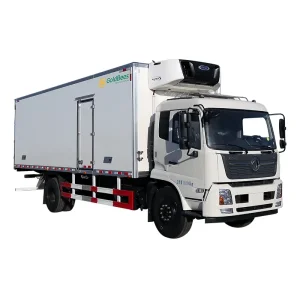
Complementary transport units engineered to support biosecure feed-to-food cold chains and end-to-end livestock logistics.