Engineered for extreme biosecurity, regulated microclimates, and uncompromising animal welfare standards.

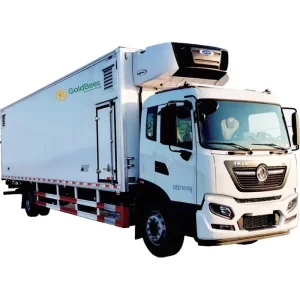




Evaluating semantic demand, regulatory challenges, and total cost of ownership (TCO) across worldwide cold distribution corridors.
Traditional refrigerated containers suffer from structural thermal bridging, causing an average of 18% thermal leakage over 5 years. Xinbaiqin integrates continuous vacuum-bonded polyisocyanurate (PIR) cores and food-grade glass-fiber reinforced polymer (FRP) seamless skins to eliminate convective joints, guaranteeing steady sub-zero retention.
With escalating ESG criteria and inner-city emission mandates across the EU, North America, and East Asia, our custom New Energy Vehicle (NEV) electric feed and refrigerated chassis decouple temperature stabilization from internal combustion power takeoff (PTO), saving up to 34% energy cost per cycle.
Animal protein loss caused by biological contaminants (such as ASF or Avian Influenza) requires heavy-duty wash-down resiliency. Every GoldBees chassis is engineered to endure repeated alkaline/acid wash cycles, pressurized caustic hot water, and automated post-wash thermal drying up to 75°C.
Backed by CP M&E (Charoen Pokphand Group), our vehicles are calibrated against actual operational feedback from international mega-farms and distribution hubs.
Designed specifically for multi-tier live haulers (pigs, broilers, day-old chicks) and combined ambient-chilled cargo. Independent zone HVAC units continuously sample carbon dioxide, relative humidity, and temperature variations.
Auger conveyor discharges and pneumatic transfer mechanisms are dynamically counterbalanced to minimize pellet attrition and prevent material shearing during feed handoffs to high-standing silos.
Our modular superstructure integrates seamlessly on premier global commercial chassis, including Scania, Mercedes-Benz, Volvo, ISUZU, MAN, FAW, and Foton, meeting regional homologation norms with minimal cycle times.
Overcoming regulatory friction with homologated structural design, regional spare part channels, and dedicated engineering documentation.
Tailored operational configurations solving complex logistics bottlenecks across the food chain.
Day-old chicks are fragile and cannot regulate body temperatures. Our controlled transporters supply 32°C constant temperatures with HEPA-filtered clean air cycles, reducing transit mortality to below 0.05% across 1,000-kilometer routes.
Moving high-value breeding pigs and finished hogs over long inter-state highways requires automated internal drinking troughs, water mist cooling systems, motorized lifting decks, and air-filtration biosecurity chambers.
Designed for urban food purveyors requiring frequent stop-and-go cycles. Multi-temperature partitions preserve frozen carcasses at -18°C while maintaining fresh dairy and produce at +4°C without temperature cross-contamination.
Where internet-of-vehicles (IoV), dynamic automation, and next-generation thermal composite science converge.
Integrating predictive AI algorithms directly into vehicle telematics. Continuous monitoring of vibration, thermal decline curves, and door-opening duration accurately warns fleet dispatchers of compressor issues before cargo spoils.
Transitioning toward 100% recyclable thermoplastic resins and structural honeycomb panels. This reduces embodied manufacturing carbon while decreasing body tare weight by an extra 12% to boost payload limits.
Pioneering direct docking interfaces between autonomous live-bird catching harvesters and transport chassis to eliminate human handling, reduce bird stress, and expedite turnaround times at processing plants.
Clear answers covering customization parameters, manufacturing capacities, and regulatory compliance.
From semi-trailers to automated agricultural harvesters, explore our precision-built machines.





