
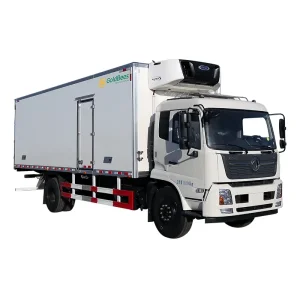
High-Quality Goldbees Refrigerated Cold-Chain Truck (Egypt Tropical Edition)
Designed for dense inner-city and inter-governorate distribution with ATP Class FRC thermal insulation and dual-evaporator multi-zone chillers.
View Vehicle Specs →Engineering tropicalized refrigerated vehicles, multi-temperature biosecure semi-trailers, and farm-to-port logistics assets designed for extreme Sahara heat and high-yield agricultural export corridors.
Pre-engineered thermal transport units designed to handle Egyptian operating corridors from Toshka to Alexandria Port.
Designed for dense inner-city and inter-governorate distribution with ATP Class FRC thermal insulation and dual-evaporator multi-zone chillers.
View Vehicle Specs →
High-cube tri-axle semi-trailer engineered with aerodynamic side skirts, continuous sub-floor ducting, and independent diesel generator chillers.
View Vehicle Specs →
Integrated mobile field pre-cooling, sorting tables, and ventilated chill lockers tailored for delicate citrus, table grapes, and berry export logistics.
View Vehicle Specs →
Turnkey agro-industrial logistics systems bridging animal nutrition processing with high-capacity bulk pneumatic loading fleets across North Africa.
View Vehicle Specs →A strategic overview of national megaprojects, agri-export corridors, pharmaceutical distribution standards, and extreme ambient operating environments.
Egypt serves as the pivotal transshipment hub connecting Africa, the Middle East, and Europe. With accelerated expansion in the Suez Canal Economic Zone (SCZone), East Port Said, Damietta, and Alexandria, cold chain vehicles represent the critical physical link sustaining multimodal trade corridors. Transporting temperature-sensitive perishable exports demands uncompromising reefer reliability to prevent cold-chain breaks between desert packing houses and marine terminals.
National mega-reclamation initiatives such as the New Delta Project (Mostaqbal Misr) and the revitalized Toshka Lakes basin are reclaiming millions of feddans of arid desert. These deep-inland farming sites harvest premium citrus, table grapes, dates, and onions under ambient conditions often exceeding 45°C. Without robust Class FRC heavy-duty refrigerated trucks, field heat cannot be effectively arrested before transit to domestic population centers or maritime export gateways.
The inauguration of "Gypto Pharma" (Egypt's Medicine City) and stringent regulatory directives from the Egyptian Drug Authority (EDA) have reshaped pharmaceutical transit requirements. Moving vaccines, biologics, and active pharmaceutical ingredients (APIs) mandates strict +2°C to +8°C and -20°C to -80°C continuous cold storage. Compliance requires dual-circuit telemetry, autonomous power generation, and zero thermal variance throughout the transit lifecycle.
Overcoming the physics of thermal radiation, abrasive silica dust, and coastal salinity through advanced vehicle metallurgy and composite aerodynamics.
Conventional vehicle bodies constructed with aluminum or steel ribbing suffer massive thermal loss in desert heat. GoldBees manufactures its superstructures using vacuum-bonded sandwich panels featuring self-extinguishing polyisocyanurate (PIR) and high-density polyurethane (PU) cores. Structural skins are joined via specialized structural adhesives and thermally isolated pultruded composite profiles, completely eliminating metallic thermal bridges.
Desert storms (Khamaseen) carry fine silica particulates that rapidly foul standard refrigeration condenser coils, triggering high-pressure compressor cutoffs. GoldBees units for the Egyptian market incorporate multi-stage cyclonic pre-filtration, electro-coated anti-corrosion condenser fins, and pressurized auxiliary compartments that shield critical electrical circuitry from dust ingress.
Intense solar radiation creates skin temperatures exceeding 75°C on vehicle roofs in Upper Egypt. Our exterior paneling uses high-gloss, UV-stabilized fiberglass-reinforced polyester (GRP/FRP) infused with specialized titanium dioxide (TiO₂) reflective pigments. This lowers solar absorption by up to 32%, directly reducing refrigeration engine runtime and lowering fleet fuel consumption.
| Technical Parameter | Standard Regional Spec | GoldBees Egypt-Tropical Spec | Fleet Commercial Advantage |
|---|---|---|---|
| Insulation Core Material | Standard Expanded Polystyrene (EPS) | High-Pressure Foamed PU / PIR (45 kg/m³) | 35% improvement in thermal retention; zero core breakdown |
| Thermal Conductivity (k-value) | 0.038 - 0.045 W/m·K | ≤ 0.021 W/m·K | Achieves ATP Class FRC compliance under 50°C ambient |
| Condenser Ingress Rating | IP54 standard electrical housing | IP68/IP69K sealed connectors + Sand Trap | Eliminates electrical shorts and compressor trips in sandstorms |
| Sub-Floor Air Circulation | Flat floor with manual wooden pallets | Integrated extruded aluminum T-profile subfloor | Ensures 360-degree cold air circulation below cargo pallets |
| Reefer Power Source | Direct vehicle engine drive only | Dual-power (Independent Diesel + 380V Standby) | Enables warehouse cold soak without consuming vehicle engine hours |
How institutional fleet operators balance upfront capital expenditure against long-term operational resilience and diesel consumption.
Refrigeration accounts for up to 25% of total operating fuel expenditure during hot Egyptian summers. By engineering high-density lightweight composite bodies, GoldBees vehicles reduce deadweight (tare weight) while lowering refrigeration cycle frequency. Reduced thermal leak rates translate to an average reduction of 1.4 to 2.2 liters of diesel per hour of cooling runtime.
The Egyptian General Authority for Roads, Bridges and Land Transport strictly enforces gross vehicle weight (GVW) and per-axle load limits across federal highways. Utilizing high-tensile Domex steel for trailer chassis sub-frames paired with optimized composite paneling provides an additional 1,200 kg to 1,800 kg of legal payload capacity per intercity transit trip.
Modern enterprise procurement teams demand complete temperature datalogging to satisfy ISO 22000, HACCP, and global retail standards. GoldBees vehicles feature multi-sensor telematics nodes interfaced with local Egyptian GSM networks (Vodafone, Orange, Etisalat, WE), streaming temperature, humidity, door-opening frequency, and GPS geo-fencing alerts to dispatch centers.
Simplifying fleet deployment through strict adherence to Egyptian customs procedures, import frameworks, and national safety bodies.
Our vehicles are manufactured to conform with Egyptian Organization for Standardization and Quality (EOS) requirements alongside international ATP (Agreement on the International Carriage of Perishable Foodstuffs) benchmarks. Every refrigerated truck body leaves the factory accompanied by certified thermal insulation certificates, pressure decay test results, and compliance documentation ready for ministerial licensing.
To eliminate demurrage and clearance delays at Sokhna, Alexandria, or Port Said, our international logistics arm fully operates within Egypt's National Single Window for Foreign Trade Facilitation (Nafeza). All Advance Cargo Information (ACI) numbers, digital invoices, and verified packing declarations are mapped directly through CargoX, ensuring seamless customs processing.
Fleet uptime depends on the immediate availability of replacement wear items. GoldBees maintains standardized component architectures compatible with widespread Egyptian service networks. Critical parts including door seal gaskets, latch assemblies, internal LED lighting modules, and condenser drive belts can be sourced quickly, supported by factory-trained mobile field technicians.
Aligning special vehicle engineering with Egypt's National Climate Change Strategy 2050 and the transition to smart green logistics.
Egypt boasts some of the highest solar irradiance levels in the world, exceeding 2,400 kWh/m² annually. Our upcoming vehicle series integrates ultra-thin, high-efficiency monocrystalline solar panels directly into the composite roof skin. These arrays trickle-charge the refrigeration auxiliary battery banks, keeping the cabin chilled during staging without idling diesel engines.
By continuous monitoring of compressor discharge pressure, thermal absorption rates, and box temperature recovery curves, on-board AI edge processors identify impending refrigeration system anomalies before cargo spoils. Alerts direct drivers to nearest authorized repair depots across the Cairo-Alexandria agricultural road or regional expressways.
As green industrial corridors develop around the New Administrative Capital and green ports, GoldBees is pioneering battery-electric vehicle (BEV) refrigerated truck architectures. These units pair high-capacity lithium iron phosphate (LFP) traction packs with high-voltage DC electric scroll compressors, providing completely emission-free final-mile cold chain operations.
Authoritative guidance addressing vehicle procurement, cooling engineering, and operational workflows across Egypt.
Explore our comprehensive lineup of biosecure livestock carriers, automated bulk feed trailers, and high-cube cold chain transport platforms.

Advanced commercial poultry farm automation hardware providing seamless climate control, feeding efficiency, and biosecure transport staging.
View Details →
Engineered to mitigate bird mortality and heat stress during summer farm-to-abattoir transit via forced mechanical air exchanges.
View Details →
Dust-free high-pressure pneumatic feed discharge designed for tall industrial silos across Egypt's integrated poultry farming complexes.
View Details →
Factory-built reefer body with movable thermal partition bulkheads, enabling simultaneous chilled dairy and frozen meat distribution.
View Details →
Heavy-payload tri-axle semi-trailer with hydraulic or electric screw auger discharge for rapid, low-breakage feed delivery to desert farms.
View Details →
Reinforced composite reefer semi-trailer engineered for intensive container-terminal shuttle duty between agricultural hubs and Alexandria docks.
View Details →
Fully washable high-grade aluminum framework and automated internal misting systems for humane, biosecure poultry transport in hot climates.
View Details →
Multiple sealed hopper compartments allowing separate poultry and ruminant nutritional formulations to be transported without cross-contamination.
View Details →Speak directly with our automotive thermal engineers to customize body capacities, chassis integration, and refrigeration configurations suited for your operating corridors.
Send Inquiry Now