
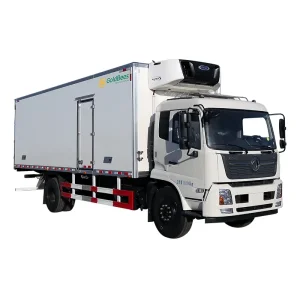
Refrigerated Logistics
Direct from our Industry 4.0 plant: high-integrity insulated bodies and specialized biosecure feed carriers built to withstand the rigorous microclimate and thermal shocks of Doha and regional distribution hubs.



Positioned at the epicenter of the Arabian Gulf, Qatar’s cold chain logistics is undergoing unprecedented structural modernization, propelled by national mandates and hostile ambient environments.
The State of Qatar’s capital city, Doha, stands as one of the world's most demanding operating theaters for commercial refrigeration and climate-controlled transport. Spurred by the Qatar National Food Security Strategy (QNFSS 2018–2030) and massive downstream investments following the modernization of Hamad Port and the economic zones operated by Manateq (such as Ras Bufontas and Umm Alhoul), the demand for high-reliability cold chain transport vehicles has reached a critical tipping point.
Operating transport refrigeration units in Doha is fundamentally unlike European or North American temperate haulage. Between May and October, ambient surface temperatures routinely surpass 50°C (122°F), compounded by coastal maritime relative humidity levels exceeding 90% along the Arabian Gulf. This extreme climatic profile imposes intense thermal stress on transport refrigeration units (TRUs), causes rapid degradation of inferior polyurethane insulation foam, and creates severe vapor drive that compromises structural joint seals.
Furthermore, Qatar's ambitious diversification into localized dairy production, poultry mega-complexes, high-value vertical hydroponic farming, and regional pharmaceutical stockpiling demands vehicles engineered for zero-tolerance temperature variance (±0.5°C). Generic truck bodies fail prematurely under these Gulf conditions, resulting in compressor burnouts, elevated diesel consumption, cargo degradation, and catastrophic cold-chain breaks that violate Qatar Ministry of Public Health (MoPH) food and medicine transport protocols.
How GoldBees by Xinbaiqin combines CP M&E electromechanical heritage with composite materials science to eliminate thermal bridging in the Arabian Desert.
Our refrigerated bodies are fabricated utilizing continuous high-pressure vacuum lamination presses. High-density, closed-cell extruded polystyrene (XPS) or polyisocyanurate (PIR) cores (45–48 kg/m³) are encapsulated by food-grade, antimicrobial glass-fiber reinforced polyester (FRP). This produces a certified overall heat transfer coefficient (K-value ≤ 0.30 W/m²·K), far surpassing ATP Class FRC standards.
To resist solar infrared radiation and prevent Gulf humidity infiltration, doors feature proprietary EPDM co-extruded four-lip gasket arrays integrated with thermal break nylon hinges. Stainless steel hardware (Grade 304/316) prevents corrosion caused by airborne saline vapor along the Doha Corniche and coastal Al Wakrah transport corridors.
Matched with premium cooling systems (Thermo King, Carrier Transicold, or high-capacity GoldBees proprietary inverter compressors), our cooling circuits feature oversized subcoolers, hydro-treated microchannel condensers, and dynamic fan staging capable of full-capacity heat rejection at 55°C continuous ambient temperature.
| Thermal & Structural Parameter | Standard Commercial Fleet Spec | GoldBees Tropicalized Doha Spec | Operational Value for Doha Operators |
|---|---|---|---|
| Insulation Thermal Conductivity (K-Value) | 0.45 – 0.55 W/m²·K | ≤ 0.28 – 0.32 W/m²·K | Up to 34% reduction in refrigeration compressor run-time |
| Core Foam Material & Density | Open-pour PU (32 kg/m³) | High-Density XPS / Hydrophobic PIR (48 kg/m³) | Zero water-weight absorption over 10-year chassis life |
| Ambient Rating of Condenser Unit | Up to +42°C (European Spec) | Tropical T-Class Certified (+55°C Ambient) | Prevents high-pressure compressor trip-outs in August |
| Internal Air Ducts & Floor Profiles | Flat aluminum sheets | Inverted-T heavy extruded subfloor + roof plenum | Ensures 360° unchoked convective airflow around pallets |
| Biosecurity Wash-Down Durability | Standard silicone seams | Seamless hot-vulcanized joints + IP69K wiring | Withstands daily quaternary ammonium and caustic cleaning |
From farm-gate biosecurity to clinical cold chain delivery, discover tailored vehicle configurations built for Qatar's premier agricultural and commercial conglomerates.
Directly servicing the needs of massive dairy self-sufficiency programs (such as Baladna in Umm Al Hawaya), our multi-deck climate-controlled livestock and bulk feed transporters provide filtered positive-pressure fresh air, misting cooling arrays, and anti-slip patented flooring to eliminate transit stress across desert highways.
Hatcheries in arid zones face high mortality rates if chick box temperatures fluctuate beyond 32°C ±1°C. GoldBees automated climate day-old chick transporters feature dedicated CO2 sensors, precision multi-stage ventilation dampers, and auxiliary diesel-electric generators that guarantee chick vitality from hatchery to broiler houses in Al Khor.
Perishable fruits, vegetables, and frozen meat entering via Hamad Port’s modern food security facility require immediate unbroken cold transfer to Al Sailiya Wholesale Market and hypermarket distribution centers across Doha. Our multi-temperature partitioned bodies allow simultaneous transport of deep-frozen (-20°C) and chilled (+4°C) items.
Engineered to satisfy Hamad Medical Corporation (HMC) and Qatar MoPH Good Distribution Practice (GDP) guidelines, our clinical-grade reefers feature dual redundant cooling loops, NIST-traceable multi-point temperature loggers, independent battery backup systems, and real-time cellular telemetry alert gateways.
Pioneering smart fleet integration: combining AI-driven telemetry, predictive thermal management, and alternative energy systems designed for GCC sustainability goals.
Every GoldBees vehicle delivered to Doha comes ready with CAN-bus connected IoT hubs. Fleet managers monitor cargo core temperatures, humidity, door opening cycles, and compressor diagnostics in real time via desktop or mobile dashboards, generating tamper-proof PDF audit logs required by Qatar municipal inspectors.
Given Qatar’s high photovoltaic potential, our refrigerated semi-trailers offer roof-integrated flexible CIGS solar panels. These modules power auxiliary lithium-ion energy storage systems, reducing TRU diesel engine idle time during city deliveries by up to 28% and ensuring zero thermal interruption during traffic hold-ups.
For stop-and-go urban drops in downtown Doha, West Bay, and Lusail, GoldBees installs ceiling-integrated eutectic PCM plates. These plates absorb surging heat spikes during door openings, maintaining strict isothermal balance without over-stressing the primary mechanical refrigeration compressor.
Engineered at Xinbaiqin Special Vehicle Co., Ltd. (in affiliation with Thailand’s Charoen Pokphand Group CP M&E), our 66,667 m² plant bridges deep agribusiness field expertise with precision industrial robotics.
Traditional European cold-chain builders impose astronomical lead times (often 9 to 14 months) and inflated markups through complex distributor chains. Xinbaiqin operates a vertically integrated special vehicle campus in Cixi, Zhejiang, delivering turnkey vehicles within 45–60 days direct to Hamad Port, fully certified and ready for road homologation.
Seamless customs clearance at Hamad Port and rapid issuance of commercial vehicle permits through strict alignment with GCC Standardization Organization directives.
All body subassemblies, rear underrun protective devices (RUPD), lateral protection side guards, and reflective contour safety tape adhere strictly to GCC Standardization Organization specifications, facilitating immediate traffic police registration in Qatar.
Wiring harnesses are fully protected in flame-retardant, anti-abrasive corrugated conduits rated to IP68/IP69K. Battery isolators, explosion-resistant interior LED lighting, and emergency break-away braking systems meet strict Qatar Civil Defense guidelines for logistics park transit.
Internal linings utilize resin formulations certified for direct food contact. Recessed floor drains with one-way hygienic rubber check-valves prevent odor entry while allowing rapid draining during sanitizing chemical washouts between dairy and meat distribution batches.
Explore our full scope of certified commercial vehicles, livestock haulers, and smart handling units available for fleet procurement in Doha and regional industrial estates.


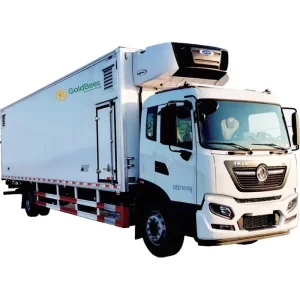


A data-driven breakdown of initial capex vs. lifecycle operating expenditure across a typical 7-year fleet service lifecycle in the Arabian Gulf.
Superior K-value insulation (≤ 0.30 W/m²·K) directly decreases engine fuel consumption on TRUs by 1.8 to 2.4 liters per operational hour during mid-day desert operations. Over 250,000 km, this saves up to $14,500 USD per vehicle in diesel costs alone.
Our lightweight high-tensile steel subframes combined with composite sandwich panels reduce vehicle curb weight by up to 1,200 kg compared to conventional steel-framed reefers, yielding higher legal payload margins per trip and saving tire and suspension wear.
In high-value meat, pharmaceutical, or vaccine transport, a single compressor cutoff event can result in insurance claims exceeding the entire capital value of the truck. Redundant cooling and live telemetry mitigate cargo spoilage risk to statistically near-zero levels.
Clear, engineering-backed answers addressing international shipping, desert homologation, chassis compatibility, and after-sales maintenance in Qatar.
Whether you require a single specialized livestock carrier for dairy expansion or a 50-unit fleet of tropicalized multi-temp delivery trucks for supermarket logistics, our engineering team is ready to deliver precision, speed, and unbeatable factory direct value.