Market Intelligence White Paper
Agro-Industrial Logistics in Istanbul & the Greater Marmara Basin
An engineering analysis of modern bulk transport dynamics, bio-secure livestock transshipment, and high-efficiency cold chain integration at the crossroads of Europe and Asia.
Strategic Eurasian Bridgehead
Istanbul serves as Turkey’s preeminent consumption market of over 16 million residents, fed continuously via intensive agricultural corridors in Thrace (Edirne, Tekirdağ) and the southern Marmara basin (Balıkesir, Bursa, Sakarya). Equipment deployed here requires cross-strait compliance (Yavuz Sultan Selim Bridge routing) and adherence to strict particulate and noise emission thresholds.
Poultry & Livestock Epicenter
The Bolu-Mudurnu and Sakarya valleys generate the vast majority of commercial poultry entering the Istanbul metropolitan area daily. Fast-turnaround live broiler transport trucks with active climate stabilization are critical to prevent mass heat-stress mortality during transit across the Marmara highway system under summer peaks reaching 40°C.
Feed Milling Scale & TCO Demands
Compound feed manufacturing around Bandırma and Çorlu has reached unprecedented density. Fleet procurement managers demand lightweight high-tensile steel and aviation-grade aluminum bodies capable of maximizing legal payload per axle while ensuring multi-compartment segregation for medicated and non-medicated pellet batches.
Industrial Transformation: Navigating the EU-Turkey Customs Union & Environmental Norms
Operating transport machinery in Turkey requires dual-facing engineering excellence. Under the EU-Turkey Customs Union framework, industrial vehicles entering the market must seamlessly satisfy stringent European standards—specifically CE directives, ECE-R58 rear underrun safety benchmarks, and precise axle weight limits enforced across Turkish General Directorate of Highways (Karayolları Genel Müdürlüğü) weigh stations. Simultaneously, operators face high domestic inflation in energy and replacement parts, meaning Total Cost of Ownership (TCO) calculations are weighted heavily toward longevity, unassisted low-wear maintenance, and structural corrosion resistance against harsh disinfection sanitizers.
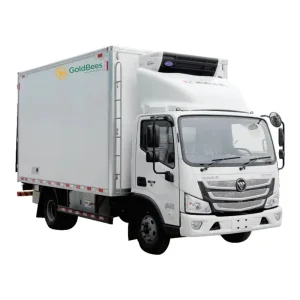
Engineering Advantage: GoldBees special vehicles bridge this divide by deploying ultra-high-strength Q700/QSTE700TM structural steels and robotic continuous welding. This architecture reduces unladen tare weight by up to 18% compared to traditional Turkish domestic coachwork, directly delivering 1.8 to 2.5 metric tonnes of legal bonus payload on every haul across the Bosphorus crossings.
15+
Years Engineering Pedigree
2,000+
Annual Heavy Unit Output
18%
Average Tare Weight Reduction
<0.5%
Feed Pellet Breakage Rate
100%
CE & ECE Compliance Ready
Global Market Shift: Decarbonization, Biosecurity, and Autonomous Animal Welfare
Globally, the animal protein and industrial logistics sectors are confronting an unprecedented convergence of biosecurity threats (such as African Swine Fever and Highly Pathogenic Avian Influenza) alongside institutional pressure to de-fossilize transport chains. Traditional, open-slat livestock haulage and manual chain-and-bucket feed unloading are rapidly becoming operational liabilities. Modern corporate integrators operating around Istanbul, across the EU, and in Middle Eastern transit corridors now require sealed biosecure envelopes.
In response, modern bulk feed transport has bifurcated into two high-efficiency streams: electric-hydraulic auger conveyance with multi-stage wireless remote positioning, and pneumatic dense-phase aeration. Pneumatic conveying enables fully enclosed pipe unloading directly into 20-meter vertical silos, completely sealing feed from moisture, wild avian vectors, and atmospheric dust. For live animal logistics, international veterinary standards now insist upon multi-deck filtered airflow systems, automated misting manifolds, integrated drinking nipples, and continuous black-box data logging of cabin temperature, humidity, and CO2 concentrations.